
For many years, I was like most anglers. When the leaves fell, I put the fly rod in the closet, and I suspect most fly rods spend the winter stored away. Depending on what part of the country you live in, you can fly fish year-round. Obviously, if you live on the coast, redfish and numerous other species are available for saltwater enthusiasts. But for those of us who live inland, trout streams seem to be the most logical choice. In addition to trout, however, there are many other species that will readily take flies, and because of this, winter provides an almost unlimited list of fish you can catch on a fly rod.

Richard Hines
Of all the fly patterns—sizes and types—poppers are the most popular, but they should not be your choice during the winter. Poppers are built to imitate large surface insects commonly found throughout the summer. When I was growing up, I had some type of popper permanently attached to the end of my fly rod. Bluegill and bass were my primary targets. At that time, there were no YouTube videos, and if I remember correctly, there was only one book on fly fishing in our school library. I never knew you could catch fish on a fly rod throughout the winter months, but years later I broke over into winter fly fishing. Rainbow trout were my first choice. As the years went by, I found that I could catch the same fish I targeted in the summer—plus many more—during the winter. I never looked back. Winter also provides fly anglers with opportunities to catch some relatively unusual species you might not have considered pursuing with a fly rod.
One winter fly-fishing enthusiast I know is Bill Carman. Carman runs Kentucky Wild Outdoors (www.kentuckywildoutdoors.com). He guides and instructs fly fishing in his seminars and along streams in Kentucky—not only for trout but also for smallmouth bass and several other stream species. Carman said, “Apart from those bitterly cold days, there is a certain amount of beauty to fishing in the winter, even when snow is on the ground—and best of all, you won’t have to fight the crowds for a fishing spot.”
Coast to coast, the best-known and most recognized species that fly fishers pursue in the winter months are trout. It’s not your imagination that trout seem to actively feed year-round. According to Carman, “Even when water temperatures are in the 40s, trout have to feed to stay active. Through the winter months, it’s not unusual for many aquatic insect species to hatch, particularly on cloudy and misty days.” He added, “This doesn’t happen all the time, but it does happen.” During the winter, fly fishers should use smaller flies and nymphs and keep a selection of dry flies handy in case a hatch occurs. Like all winter fishing, small and slow is the key. Carman noted, “A zebra midge is a good choice.” In many cases, a midge stripped (retrieved) slowly will get the attention of a trout or other fish during the winter months.
While trout are the most popular target for winter anglers, they are just one of many species that winter fly fishers can catch. One of my favorite winter fish has always been the sauger. I’ve caught this member of the perch family for years, but I had never considered catching them on a fly rod until one of my fishing partners and former co-workers, Charlie Logsdon, taught me how to catch them at dams along the Ohio River. This close relative of the walleye is found in most watersheds along the northern tier of the Mississippi River, including the Ohio and Missouri Rivers.
Every winter, sauger begin their annual “run” by early November, and if you have open water, they remain catchable into late January and February. Since sauger are found in ample numbers, I always keep a stringer handy. Like walleye, sauger are excellent table fare. For many years, I caught sauger on a spinning rod. My favorite lure for the past twenty years was always a chartreuse and black Road Runner® spinnerbait. However, since switching to a fly rod, I now use a modified woolly bugger with a small lead head or a brightly colored Clouser Minnow. Just like the Road Runner I used for years, I continue using bright, contrasting colors such as red and black, chartreuse and black, or orange and black.
Sauger typically feed along the bottom, so it’s important to keep your fly as near the bottom as possible. Because of this, I expect to lose some flies. To help get them down into the “dark” portion of the water column—and depending on the current—I use a small added lead weight, about BB size or slightly larger. Some anglers use a weighted forward line. Either method works. Another point to remember is that sauger are not particularly fond of bright light, so pick overcast days and/or fish early in the morning or late in the evening for the best results.
Richard Hines
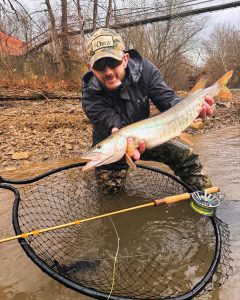
Every angler, whether using a fly rod or conventional spinning gear, has that one species that has eluded them. For me, that species is muskie. Some of our local muskie streams—only a 30-minute drive from my house—continue to baffle me. One individual who had mastered catching muskie on the fly rod was the late Hunter Smith. A U.S. Army veteran and VA nurse, Smith guided and fly fished every day he wasn’t working, even through the winter months. Although he was only in his twenties when he was killed in a car accident, Hunter taught me more about fly fishing than I can even begin to recall. He always preferred scheduling most of his muskie trips here in Kentucky during the winter.
During the colder months, muskie move into slightly shallower water. Best of all, you’ll encounter less boat traffic in the winter, which not only makes the trip more pleasant but also reduces the chance of a boat spooking fish—something muskie are notorious for. The slightest disturbance will send them darting under any available cover.
Be sure to step up your equipment for these trips. Bill Carman, who also fishes for muskie with an 8-weight rod, said, “Any baitfish imitation should get their attention.” I use a heavier 12-weight rod. It’s larger and can wear you down after several hours of casting, but it’s necessary to handle these powerful fish.
Known as the “fish of 10,000 casts,” muskies are occasionally hooked by accident, but most of the time you must truly hunt for them. Over the years, I’ve picked up valuable information about muskie from my friend Mr. Willard Parnell. Parnell, now 98, caught Kentucky’s record muskie in 1968, and later broke his own record in 1970 with a larger fish. He knew the second record fish was in a certain section of Green River. “I hunted that fish for two years before I caught it,” Parnell said. “Fishing along small rivers for muskie requires anglers to think like they’re stalking a big buck.” Parnell even used padding in the bottom of his boat to avoid making sound. “The minute you enter their home pool, you can bet they already know you’ve arrived,” he said.
Muskie are now getting attention from many fly anglers, and several guides now specialize in targeting this trophy species on the fly.
In addition to these species, I’ve also caught hybrid striped bass, white bass, drum, longnose gar, and various bass during the winter months.
If you’re new to fly fishing—or just need a refresher—there are numerous clinics and seminars available throughout the winter months. Many U.S. Fish and Wildlife Service hatcheries across the country, including Wolf Creek Hatchery, offer fly-fishing seminars that provide hands-on instruction for new anglers.

Richard Hines
Winter is also the perfect time to visit a fly-fishing store to get matched with the right rod and new equipment. Mike Parker, who works at Quest Outdoors in Louisville, Kentucky, was a fly-fishing guide in the western U.S. for over twenty years. Between Mike and his staff, the store has more than 200 years of fly-fishing experience. One thing you’ll hear from Quest—and from hundreds of other small, independent fly shops—is that you’re never obligated to buy their rods, but the real advantage of small fly shops is building a relationship with experienced staff who are only a phone call away.
In most cases, that first fly-fishing outfit you buy at a big-box store may be cheaper, but you probably won’t be able to step outside for a practice cast. Like many small shops, Parker said, “We take people outside and help them cast all the time. From trying new equipment to helping you work out a problem with your casting, small shops can take the time you need to fine-tune your techniques.” Winter is the best time to get matched with a good fly rod.
Parker added that there are numerous beginner kits available—and there’s nothing wrong with them. Most starter fly kits include a 9-foot rod matched with the right reel and line. Depending on where you live and which species you’re fishing for, your rod weight selection will usually range from 4- to 6-weight rods.
If you’re a baitcasting or spinning rod angler, fly-fishing equipment may seem overwhelming at first, but that’s where small independent shops can really help you assemble the right setup—including your fly box. With fly names such as Hare’s Ear Nymph, Black Gnat, and Woolly Bugger, it can get confusing, so talk with your local shop to select the best flies for your area. When I travel, I always stop by the local fly shop to get advice on productive flies and promising fishing locations.
There are numerous publications on fly fishing that provide guidance, and fly-fishing books are more plentiful than ever. Add to that hundreds of instructional videos, and you’ll have no shortage of resources. I subscribe to two fly-fishing magazines. One is a free online publication called “On the Fly South Web Journal,” published by lifelong fly angler Jimmy Jacobs and co-editor Polly Dean (https://ontheflysouth.com).
A member of the Southern Fly-Fishing Hall of Fame, Jacobs and Dean provide up-to-date information on fishing locations, organizations, seminars, trade shows, and equipment updates.
If you’re still hesitant to hit your local stream during the winter months, take time to find instructional seminars or join one of the many fly-fishing organizations eager to welcome newcomers. Almost every state has multiple fly-fishing clubs or associations.
Finally, where can you go to fly fish during the winter? Start by visiting a state’a fish and wildlife department’s website. Since trout are among the best choices for beginning your winter fly-fishing adventures, many national forests have designated trout streams—and there’s at least one national forest in every state. These, along with state fish and wildlife agencies, often offer “catch-and-release” seasons that allow trout to hold over through the winter. When these seasons are set, fishing pressure drops dramatically, providing you with the opportunity to have the stream to yourself.
One word of caution: fly rods are like shotguns—you can never have too many! While I already have a good selection of rods for bass, crappie, and catfish, for some reason, fly rods seem to be accumulating at a faster rate. It’s one of the hazards of this sport!
-
Join our weekly newsletter or subscribe to Gamekeepers Magazine.
Your source for information, equipment, know-how, deals and discounts to help you get the most from every hard-earned moment in the field.